
Every town has its saint. Maybe every generation in every town has one. When and where you grow up, if you’re lucky, you might get to know one. I know they exist because I’ve met a few of them, but I’ve never known anyone quite like Jarvis, who was like a second father to an entire generation of kids in my hometown of Plainview, Minnesota.
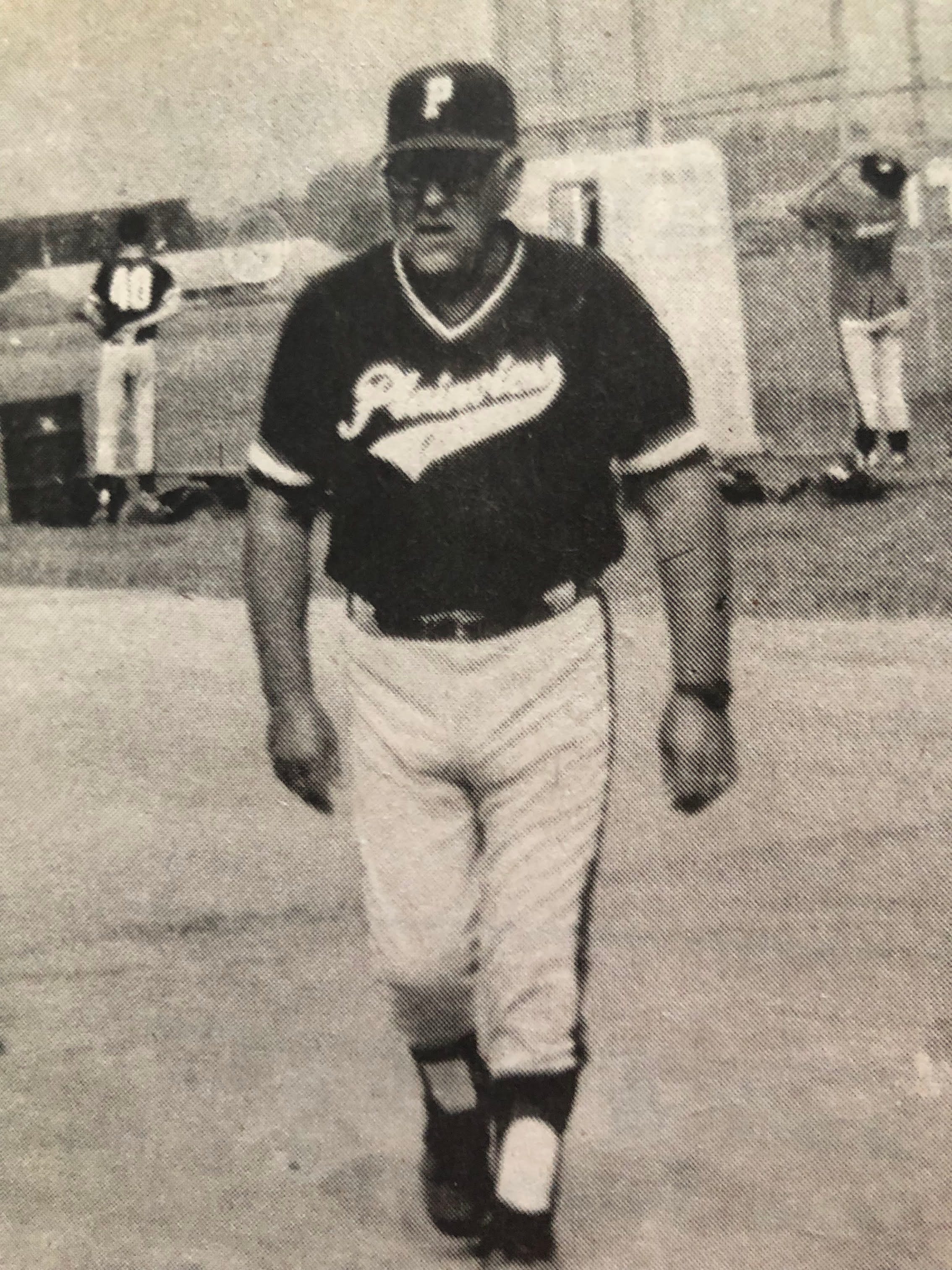
Before sports became a year-round pursuit for families that cost thousands of dollars, we had Jarvis. He and a few teenage summer workers would round up kids and play baseball, usually in the grass, not on any groomed infields. Some of us wore blue jeans while playing. After a few years of underhand slow-pitch with a ragball, we graduated to using real baseballs and pitching. Then we had helmets, but both teams had to share a total of four helmets between them - just enough so that if the bases were loaded, the batter still had a helmet. I remember passing around water jugs where many of us would drink from the same bottle, with germs being the last thing on our minds.
We even shared the same bat. Often, both teams would use the same bat. When I played we had one special bat, called the “Little Greenie,” which was a small green Easton bat, not to be confused with the “Big Greenie,” which was a few ounces too heavy. The bat came to have a kind of magical quality to it, so that when we had one of our three travel games, where we loaded up a bus and drove five or ten miles to a neighboring town, having the Little Greenie along with us meant having a chance at victory. There was something about the bat, or so we thought. With that bat, we could face the legendary ten-year-old pitchers from Elgin, Eyota, or St. Charles. The Little Greenie was like a sword for battle when facing the heat from the kid five miles away who seemed like a giant on the pitching rubber. I still remember the day when the Little Greenie broke, in St. Charles, Minnesota, when the handle snapped. It was a sweltering day and we all had gobs of sunflower seeds in our cheeks. We gasped in shock when the batter swung and the handle separated from the barrel. It was as if we’d lost power because we no longer had Little Greenie. Jarvis assured us that baseball would continue, and that we could use the Big Greenie instead, we’d just have to swing harder. Losing that bat was like the death of a beloved pet. Maybe we all learned a valuable lesson about superstition that day, but probably not because we had other ones, like rally caps (in its various forms, such as upside-down hat, inside-out hat, shark-fin hat, or shaking our hats like a collection plate, etc.) and I still wouldn’t step on the chalk line while going to play the field, as if it were a black cat.
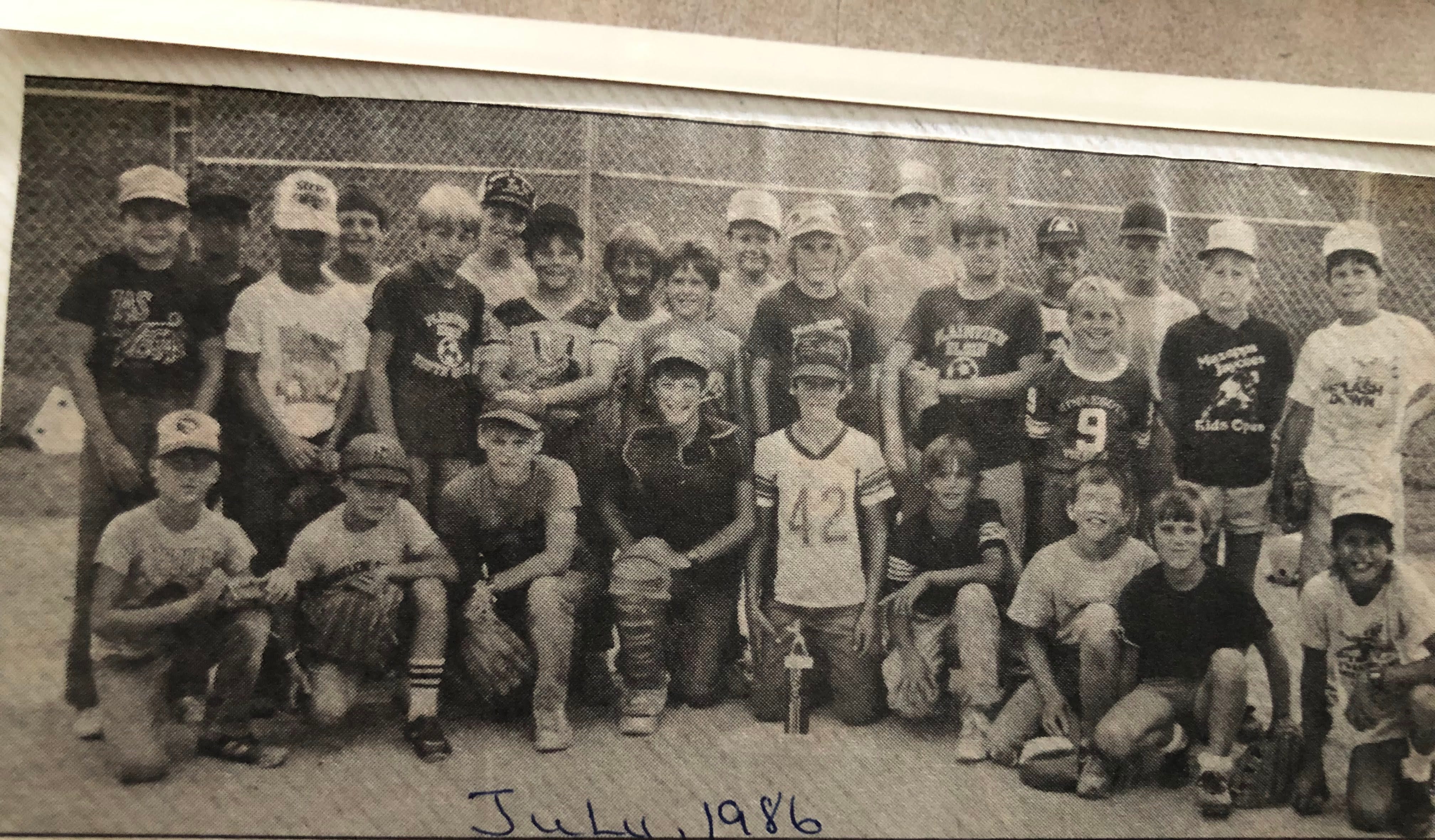
On those hot summer days, we could flock around Jarvis and await instruction before scattering to one of those grassy fields, and he would teach us baseball fundamentals and somehow, subtly in the middle of skill training, try to teach us how to live. I’m not sure how well I listened, but he was doing it. Sometimes a lesson takes thirty years to settle in. When he taught us how to field the ball, we did a drill called “Knees, Hands, Bowl” where he showed us how to duck walk and gather ground balls, and we would laugh about how basic “Knees, Hands, Bowl” was and how seemingly unnecessary, but then many years later when I started coaching youth softball, I found myself lining up the girls and saying, “Knees….Hands…Bowl!”
When our games ended, after we got a taste of glory or defeat, if the day allowed it (and if our parents allowed us to linger), we would walk in our grass-stained pants to the swimming pool and spend a few hours running wild and having the time of our lives. It’s was these days when we were most alive and we didn’t even realize it. Because I can still see my friends’ faces at the pool, laughing, diving, getting benched by the lifeguards for acting like fools. But the days seemed so long, like the sun had stopped moving, until finally the 5:00 whistle sounded and it was time to go home for dinner, exhausted but so alive that you never wanted it to end.
Leaving the baseball field, I remember frequently seeing Jarvis getting on the tractor to drag the main field, or to mow the outfield, or to dig up bases. Or he would just be putting gear away in a little shed. His time and talent was always being freely given. The strange thing about Jarvis was that he would always talk about baseball, but he would rarely talk about winning or losing. He also never talked a great deal about the major leagues, and even though I knew he watched the Minnesota Twins, he didn’t seem overly concerned about it. There was never any talk about our future baseball plans, because we just played for the day. It was more important to be playing and be trying our best, and that was that. Being in the moment of each day seemed enough, and that was how it felt with him from five years old until I was eighteen.
Without a doubt, he was the greatest example of Christian witness through his life of anyone I’ve ever known, and he did it in a way that was gentle and honest. If anyone seemed to know the meaning of “dying to self” and “carrying your cross” in this life it was Jarvis. And he took a lot of mockery for it, for various things, from his being too gentle, to his physical maladies, to his totally open spirituality. The only thing he would have been ashamed of in this world would have been if he had denied Jesus. He told us the same joke several times, that the Bible opened up with a line about baseball, as Genesis 1:1 said, “In the big inning” rather than “In the beginning.”
He was a man of seemingly infinite patience, but I found the limit, as I tested it several times as I grew older. I tested even while I was young, too. In one of his ways of reaching kids and guiding them, he ran an open gym on Wednesday nights in the winter for kids that didn’t attend religious classes. The kids were allowed to run wild and play basketball and dodgeball, but halfway through they had to stop and sit down for five minutes, where Jarvis would read one Gospel story, and then we would talk about it for a few minutes. He had to teach it through the snickers of hyper youth. When I attended, I liked to mess around during the reading and ignore Jarvis, seeking attention for myself, but catching an eye from Jarvis I would cool it because I knew he deserved it.
Rarely, did he get angry. He was slow to anger. Jarvis allowed us to cooperate with him or rebel, and he gave us the freedom to find out how poorly rebellion worked in practice.
In high school, things became more serious, but never that serious. Jarvis knew the baseball rulebook so well that when an umpire made a bad call, we would smile as Jarvis got up from the bench in the dugout, because we knew that he was going to give the umpire the chapter and verse of the baseball rulebook - verbatim. And without blowing up at the umpire, he would calmly argue a fine point that we all knew the umpire could not reverse or change. It usually had something to do with a balk, and Jarvis would be out in the field, quietly making pitching motions, breaking his hands and showing the umpire why the opposing pitcher had balked.
The few times I saw him get angry was when I lied or shirked a responsibility. Ok, so once I saw him get mad when I made a boneheaded base running move that we had gone over many times. In particular, I remember batting in a 1-0 game that we were losing, in the bottom of the last inning. He gave me the sign for the suicide squeeze bunt, and not being much of a bunter, I screwed it up. I pulled my bat back because the pitch was bad, treating it like a regular bunt situation. The runner at third nearly got thrown out because I failed to put my bat on the ball, but he made it safely back to third base. Jarvis was so angry with me. In response, I got so angry at him back. I was furious. On the very next pitch, in my rage, I hit a home run. We won the game, 2-1. But rounding third, Jarvis and I were still mad at each other. That was one of my few home runs, and it was my only walk-off home run ever, but it was bittersweet. I will never forget it, and I knew why he was angry - he expected more, and I was already slipping into bad habits on various aspects of life. It probably wasn’t the squeeze bunt that had made him angry. It was everything else I was doing in life. He saw the slide happening.
When we lost a game to go to the state tournament, we were all in a funk of despair, and he still hummed a tune. He told us, “Tomorrow, the sun will come up over those fields, just like it did today.” A loss did not change anything, really no more than a win did. He understood taking life on life’s terms. He understood what it meant to conform his will to God’s will. But I learned a few years later that such grace came hard-earned, from lessons learned, and his own journey that led him to become the servant of Plainview became an instruction manual for myself to return to the right path of life. He was not born as the baseball saint of Plainview, he grew into it by cooperating with a greater plan for his life.
I know other towns have people like Jarvis. I know some of their names just from Southeast Minnesota, where people give up the self for his faith and love of others. In fact, I’ve met quite a few of them outside of sports now, but through baseball, Jarvis met us where we were at, when we were children. Just by the beauty and joy of playing a game, organized just enough but not too much, he showed us a way of life that made baseball important, but not of ultimate importance. It was always a good reminder, that sports was intended to be a child’s game, not the center of our lives. He was allowing something higher to work through him, teaching us about first-and-third situations and cutoff positions, but he was really glorifying creation. He did what we are called to do, to stifle our own egos and desires in exchange for the kingdom, for others, for eternal life. If but a few of us make it to heaven, he will be one.
He had a way of guiding us that was funny and honest. When someone would shout “Jesus Christ,” taking the Lord’s name in vain, he would ask, “How would you feel if every time something bad happened, we would yell your name in anger?” Then he would say the person’s name several times in anger, and we would laugh, and even the person he was naming would laugh, but the point was made. That story stuck with me, and I probably used the Lord’s name in vain a thousand more times before I stopped and realized what Jarvis really meant. He didn’t bang us over the head with the fact that we were playing with fire, literally, by rejecting the second commandment.
I think for many of us boys who grew up in the 1980s and 1990s in our town, he acted as the suffering servant. We would joke and laugh about him, call him nicknames, because he was an easy target, and we did because he allowed it, and he allowed it because he loved us. When caught in the act, he would openly confront us about his life and hide nothing. He wore no fig leaves like the rest of us do. I have heard it said that if you can figure out what Adam meant when he told God, “I was afraid, because I was naked, so I hid,” then you will understand everything that you do and what everyone else is doing as well. Jarvis was not hiding. He was in the arena, while still being open and vulnerable, and because of the grace he allowed in, everything bounced off of him. We couldn’t hurt him with our mockery and nicknames because he had his faith at the center of his life, and nothing could de-center him from that rock. If we could all get rid of our fig leaves that we hide behind, we would be free. Jarvis didn’t much care about money, honor, pleasure, or power. He cared about Jesus, loving one another, and keeping all of God’s commandments. And he showed it through his life.
Some final thoughts.
He was an excellent whistler. I don’t think he listened to any modern music. In the dugout, he would whistle Hail to the Victors, the Notre Dame Fight Song, or Minnesota Rouser. I often wondered if those were the only songs he liked.
One time making hay at his farm, I was riding in a wagon as the kicker threw bales at me. When we got on a steep incline, the whole wagon tipped over. The world spun around me as it toppled, and one second later I landed, followed by about fifty bales of hay. I was underneath the pile. When I popped my head out of the stack, Jarvis was sitting on the tractor. When he saw that I was not dead, he laughed. Then I laughed, too. I was really itchy the rest of the day.
He paid us a quarter per ball to shag foul balls during high school tournaments. Other times, he would just give us a “game ball,” one of the balls used in the tournament, and it seemed to have great value, to know that the high school pitchers and batters had touched it, and now we got to keep it and take it home.
He would take a school bus on an annual trip to a Minnesota Twins game, with many children, maybe sixty of us, jammed into a bus, three to a seat. You probably couldn’t get away with it today. We were running around the Metrodome like feral cats, having the time of our lives, and somehow we all found our way back to the nosebleed seats for those “Knothole Day” bargain ticket games.
In the years I coached, I thought of Jarvis often. From the first practice, I tried to emulate his coaching style as best I could, trying to not freak out over bad plays, or obsess over wins and losses, because I knew that sport was purest when played and coached the way that Jarvis taught us. He believed that something had been lost when the “club” era of sports began. Trying to model his style was difficult in this era, where the focus on winning and playing time is the main focus. When Jarvis coached, it was about people, and he treated the opposing team exactly as he treated us. He wanted to win, but he didn’t need it to be happy.
When I think of my hometown, and the many reasons I love it, Jarvis is at the top of the list. There are many things that I love, like the Popcorn stand, Corn on the Cob Days, and main street, which I drove up and down a thousand times looking for excitement. There are various memories from the Legion basement, the Church where I served an altar boy, the gas station hangouts, the bar where I made a fool of myself, the parks where we played in as children and loitered in as teenagers. Even the old folks’ home brings back moments of lives and faces. I have memories of so many faces, and the run-ins with them, from all walks of life, of the variety that you can only get in a small town. There are many places and hundreds of people, all of who made it special and unique, but there is nothing quite like my memories at the baseball field, and there was no one quite like Jarvis.